
90° Elbow
Turns a line through a right angle. Long radius (1.5D) is standard; short radius (1D) where space is tight.
LR & SR · ½" – 48"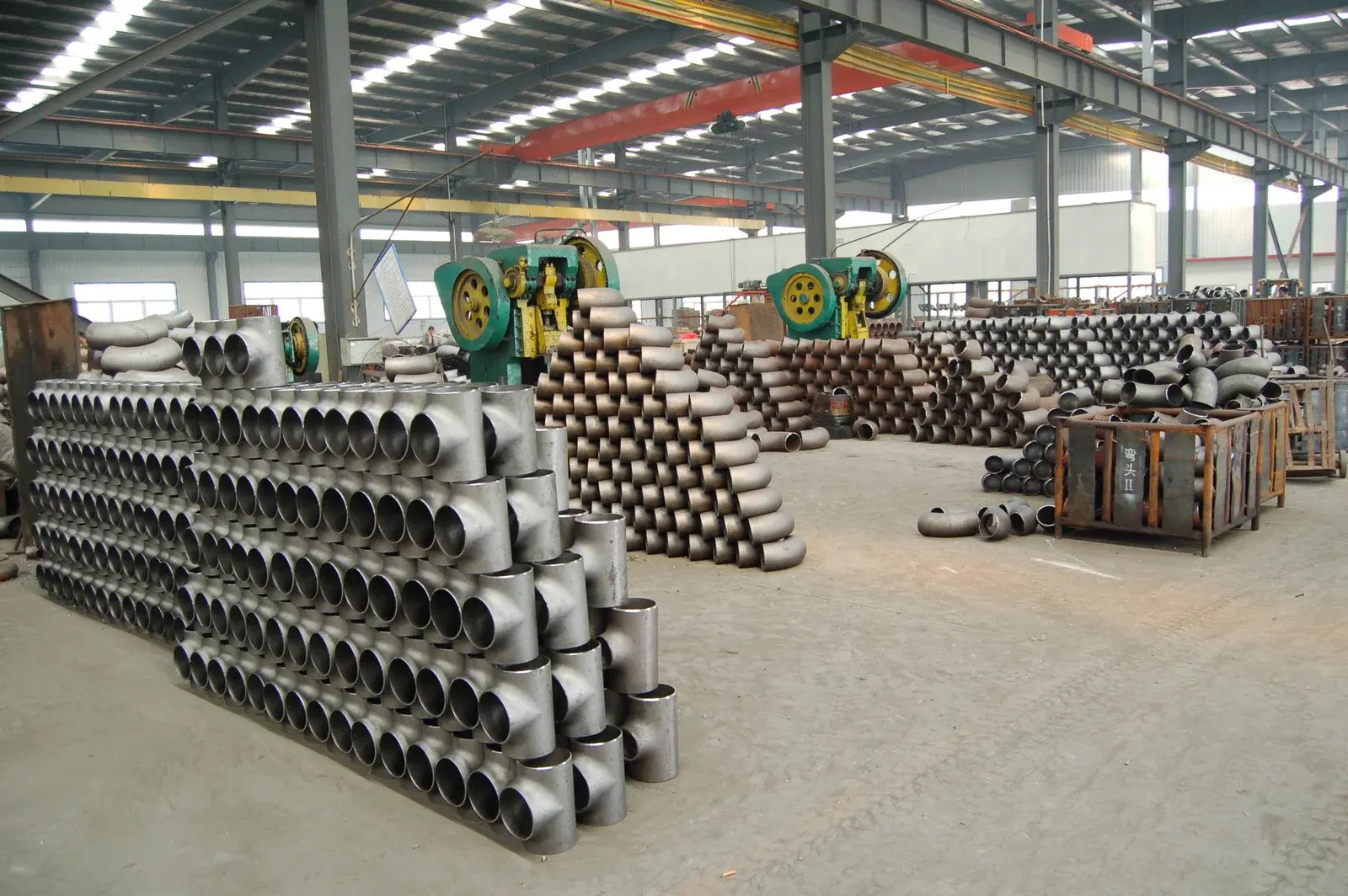
Pipe fittings join lengths of pipe and change the direction, diameter or branch of a line. Every piping system needs them, and each one must match the pipe it connects to – in material, size and wall thickness, and end preparation.
We supply seamless and welded fittings in the same grades as our pipe, so the fitting, the pipe and the flange all carry matching certification. Sizes from ½" to 48", in schedules from 5S to XXS and forged classes 2000 to 9000.
Dimensions to ASME B16.9 for butt-weld fittings and B16.11 for forged socket-weld and threaded fittings.
Turns a line through a right angle. Long radius (1.5D) is standard; short radius (1D) where space is tight.
LR & SR · ½" – 48"Gentler change of direction for offsets and routing around obstructions, with lower pressure drop than a 90°.
LR · ½" – 48"Takes a 90° branch from the run. Equal tees have the same branch size; reducing tees have a smaller outlet.
Equal · ReducingChanges pipe size while keeping both ends on the same centreline – the default for vertical runs.
Same centrelineOffset centreline keeps one side flat – used at pump suctions and in horizontal lines to avoid trapping air or liquid.
Flat on top or bottomCloses the end of a line permanently, for terminations, future tie-ins and pressure testing.
½" – 48"Four-way fitting with two opposed branches – used in fire protection loops and headers.
Equal · ReducingWelded to the pipe and used with a loose lap joint flange, so the flange can rotate for bolt alignment – and stays out of contact with the fluid.
Type A · B · CLarge-radius 3D and 5D bends for pigging, slurry and low-turbulence flow, made by hot induction bending.
3D · 5D · custom radiusWeldolet, sockolet, threadolet and elbolet – integrally reinforced outlets welded directly onto the run pipe.
MSS SP-97Full and half couplings, unions, plugs, bushes and nipples in forged socket-weld and threaded construction.
Class 3000 · 6000 · 900045° laterals, reducing crosses, mitre bends and fabricated specials made to drawing.
Made to orderButt-weld fittings are matched to pipe schedule; forged fittings are rated by pressure class.
The fitting is bevelled and welded directly to the pipe, giving a smooth full-bore joint with no crevice – the strongest connection and the standard for larger sizes and critical service.
The pipe slots into a machined socket and is fillet welded on the outside. Quick to fit and well suited to small-bore, high-pressure lines.
Screwed connection (NPT or BSP) for lines that must be dismantled, for utilities and where welding is not permitted.
| Option | Dimension | Choose it when |
|---|---|---|
| Long radius elbow (LR) | Centre-to-face = 1.5 × NPS | Default choice – lower pressure drop and less erosion |
| Short radius elbow (SR) | Centre-to-face = 1.0 × NPS | Space is restricted; accepts higher pressure drop |
| 3D / 5D bend | Radius = 3 or 5 × pipe diameter | Pigging, slurries, abrasive or high-velocity flow |
| Concentric reducer | Both ends on one centreline | Vertical lines and pump discharge |
| Eccentric reducer | Offset centreline, one side flat | Horizontal lines – flat side up avoids air pockets at pump suction; flat side down aids drainage |
Fitting grades are the wrought equivalents of the pipe grades – "WP" for wrought pipe fittings, "F" for forged.
| Material Family | Grades | Standards | Typical Service |
|---|---|---|---|
| Austenitic Stainless Steel | WP304, WP304L, WP316, WP316L, WP321, WP347 (forged: F304/L, F316/L) | ASTM A403, A182 | Chemical, food & dairy, pharma, general process |
| Duplex & Super Duplex | WPS31803, WPS32205, WPS32750, WPS32760 (forged: F51, F53, F55) | ASTM A815, A182 | Seawater, desalination, oil & gas, chemical tankers |
| Nickel Alloys | Inconel 600 / 625, Monel 400, Hastelloy C-276 / C-22 | ASTM B366, B564 | Severe corrosion, high temperature, FGD, sour service |
| Carbon Steel | WPB, WPC (forged: A105) | ASTM A234, A105 | Steam, water, oil, general and structural piping |
| Alloy Steel | WP11, WP22, WP5, WP9, WP91 (forged: F11, F22, F5, F9, F91) | ASTM A234, A182 | Boilers, superheaters, refinery high-temperature lines |
| Low-Temperature Steel | WPL6, WPL3 (forged: LF2, LF3) | ASTM A420, A350 | LPG, cryogenic and cold-climate piping |
| Titanium | Grade 2, Grade 5 | ASTM B363, B381 | Seawater, chemical plant, desalination |
| Copper Alloys & Aluminium | Cupro-nickel 90/10 & 70/30 (ASTM B466 fittings), C11000, C26000, 6061 | ASTM B466, B16, B209 | Seawater lines, plumbing, heat transfer, light-duty lines |
Fittings are supplied to match the pipe they join – same grade, same wall.
Each fitting is marked with manufacturer, material grade, size, schedule and heat number as required by the standard. *On request.
Material specification plus dimensional standard – both are stated on the order and the certificate.
Butt-weld fittings are formed from pipe or plate; forged fittings are shaped from solid bar.
Pipe, plate or round bar of the ordered grade is cut to the blank size, carrying its heat number forward to the finished fitting.
Elbows are hot formed by pushing pipe over a mandrel; tees are cold drawn or hydraulically bulged; reducers are formed by necking or expanding; forged fittings are die forged from bar.
Forming work is relieved by solution annealing (austenitic and duplex grades) or normalising and tempering (carbon and alloy steel), restoring the required properties.
Ends are machined – weld bevels to ASME B16.25, sockets bored to B16.11, or threads cut to NPT/BSP – and dimensions brought within tolerance.
Stainless and nickel fittings are pickled and passivated; carbon steel is shot blasted and may be painted or oiled for protection.
Dimensional and NDT inspection, marking with grade, size, schedule and heat number, then packing in boxes, drums or crates.
Material tests on the certificate, plus NDT and dimensional checks on request.
Composition of the heat used for the fitting, reported on the mill test certificate.
Tensile and hardness testing after heat treatment; impact testing for low-temperature grades.
Surface examination of welds and machined areas for cracks and discontinuities.
Volumetric examination of welded fittings and heavy sections, to the extent your specification requires.
Intergranular corrosion for stainless; ferrite count and intermetallic checks for duplex fittings.
Centre-to-end, outside diameter, wall thickness, bevel angle and socket depth checked to the dimensional standard.
Positive material identification by XRF or OES – confirms the alloy of every fitting before dispatch.
Mill test certificates as per EN 10204 3.1 (3.2 with third-party inspection), with heat traceability.
Small items secured, large fittings crated – bevels and threads kept undamaged.
Forged fittings in cartons or drums; large butt-weld fittings in wooden crates or pallets for export.
Weld bevels are protected; threaded ends receive caps or plugs so the threads arrive undamaged.
Stainless and nickel fittings are wrapped and handled separately from carbon steel items.
Each fitting carries its grade, size, schedule and heat number; packages are tagged to match the certificate.
Anywhere pipe changes direction, size or branches – across process and utility systems.
Process piping, flowlines, headers and manifolds
Corrosive service in stainless, duplex and nickel alloys
Steam, feedwater and high-temperature alloy lines
Hygienic process lines and CIP systems
Seawater intake, RO skids, firewater loops
Sprinkler and hydrant networks with tees and crosses
Ballast, bilge and seawater systems
Skid builders, spool fabricators and maintenance shops
Send these details and we can quote accurately – usually the same working day.
A long radius (LR) elbow has a centre-to-face dimension of 1.5 times the nominal pipe size; a short radius (SR) elbow is 1.0 times. LR is the default because the gentler turn means lower pressure drop and less erosion. SR is used where space is tight and the extra pressure drop is acceptable.
Use an eccentric reducer in horizontal lines. With the flat side on top it prevents air pockets forming at a pump suction; with the flat side at the bottom it allows the line to drain. Concentric reducers keep both ends on the same centreline and suit vertical runs.
Butt weld gives the strongest, full-bore joint with no crevice and is standard for larger sizes and critical service. Socket weld suits small-bore high-pressure lines and is quicker to fit. Threaded connections are for utilities, low-pressure lines, or where welding is not permitted and the joint may need dismantling.
They are pressure classes for forged fittings under ASME B16.11 – a higher class means a heavier body and a higher pressure rating. As a guide, socket-weld fittings are commonly matched as Class 3000 with Sch 80 pipe and Class 6000 with Sch 160 pipe; always confirm against the applicable design code.
A stub end is welded to the pipe and used with a loose lap joint flange. The flange can rotate freely for bolt hole alignment and never touches the fluid, so an expensive alloy stub end can be paired with a cheaper carbon steel flange.
Yes. Where required we supply pipe, fittings and flanges of the same grade together, each with its own mill test certificate and heat number, so the whole spool is traceable.
Type, grade, size, schedule or class and quantity – we'll confirm availability, price and delivery, and can supply matching pipe and flanges.