
Weld Neck (WN)
Tapered hub butt welded to the pipe, transferring stress into the pipe wall. The strongest flange and the standard choice for high pressure, temperature cycling and critical service.
Butt weld · Class 150 – 2500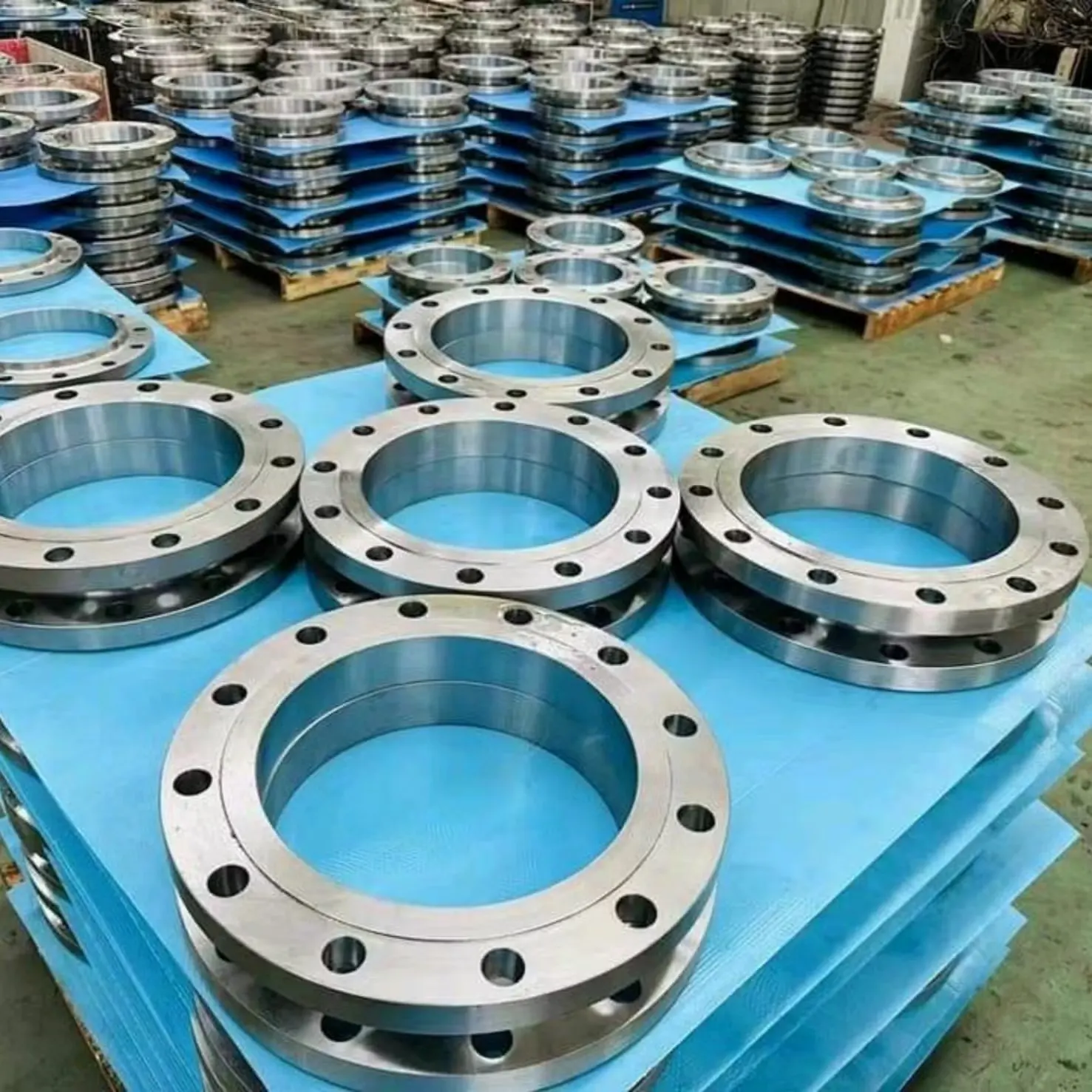
A flange is a bolted joint: two mating flanges, a gasket and a set of bolts. Unlike a welded joint it can be dismantled, so flanges are used wherever a line must be opened for maintenance, inspection or equipment removal – at pumps, valves, vessels and instruments.
Four things must match on both sides of the joint: size, pressure class, facing and standard. Get any one wrong and the bolt holes, the gasket or the rating will not line up. The sections below explain each choice.
Each drawing is a half section through the flange – the dashed line is the pipe centreline, and the orange face is the gasket seating surface.
Tapered hub butt welded to the pipe, transferring stress into the pipe wall. The strongest flange and the standard choice for high pressure, temperature cycling and critical service.
Butt weld · Class 150 – 2500The pipe slips through the bore and is fillet welded inside and outside. Easier to align than a weld neck and lower cost – widely used for low and moderate pressure.
Double fillet weld · Class 150 – 600A solid disc with no bore, bolted on to close off a line, vessel nozzle or valve. Used for terminations, future connections and pressure testing.
Solid · Class 150 – 2500The pipe seats in a machined counterbore against a shoulder and is fillet welded outside. Suits small-bore, high-pressure lines.
⅛" – 4" · Class 150 – 1500Screwed onto threaded pipe (NPT or BSP) with no welding – for utilities, low-pressure lines and areas where hot work is not permitted.
½" – 4" · NPT / BSPA loose backing flange over a welded stub end. The flange rotates freely for bolt alignment and never touches the fluid – so an alloy stub end can pair with a carbon steel flange.
With ASTM A403 stub endFull-size flange face with a smaller bore, so a line can step down in size at the joint without an extra reducer and weld.
Two sizes in one flangeSupplied in pairs with radial pressure tappings and jack screws, to hold an orifice plate for flow measurement.
Pairs with jack screwsAn extended hub that acts as the vessel nozzle itself – common on pressure vessels, columns and heat exchangers.
Vessel & nozzle serviceA solid disc and an open ring joined together – rotate it to block or open a line for isolation during maintenance. Also supplied as separate spacers and paddle blanks.
ASME B16.48Cut from plate with a flat face and no hub – an economical option for low-pressure water, air and structural connections.
Flat face · low pressureWeld neck or blind flanges machined with a ring groove for a metal ring gasket – the standard for high pressure and high temperature service.
Class 600 and aboveBoth flanges in a joint must have the same facing – and the gasket must suit it.
The most common facing – a raised ring that concentrates bolt load on a smaller gasket area. Standard height 1.6 mm up to Class 300 and 6.4 mm from Class 400 upwards.
The whole face is flat and the gasket covers it fully. Used with cast iron equipment and GRP, where a raised face could crack the mating flange.
A machined groove takes a solid metal ring gasket (oval or octagonal, type R, RX or BX). Metal-to-metal sealing for high pressure and temperature.
Matching raised and recessed faces locate the gasket precisely and prevent it being blown out – used on heat exchangers and pump covers.
Standard face finish for RF and FF flanges is a serrated spiral or concentric finish of 125–250 µin Ra (3.2–6.3 µm), which grips the gasket. Smooth or other finishes can be machined on request.
The class number is a rating designation, not a pressure – the actual allowable pressure falls as temperature rises.
| ASME Class | PN equivalent | Typical service | Common facing |
|---|---|---|---|
| Class 150 | PN 20 | Water, air, low-pressure utilities and general process | RF, FF |
| Class 300 | PN 50 | General process piping, steam, chemical service | RF |
| Class 400 | PN 68 | Intermediate ratings where 300 is not sufficient | RF |
| Class 600 | PN 110 | High-pressure process, steam and hydrocarbon lines | RF, RTJ |
| Class 900 | PN 150 | High-pressure oil & gas, boiler feed | RTJ |
| Class 1500 | PN 260 | Wellheads, high-pressure hydrocarbon service | RTJ |
| Class 2500 | PN 420 | Extreme pressure – small-bore, high-integrity joints | RTJ |
Send us these four measurements – with the facing type – and we can identify the size, class and standard for you.
Flanges are forged products – the "F" grades correspond to the pipe and fitting grades of the same material.
| Material Family | Grades | Standards | Typical Service |
|---|---|---|---|
| Austenitic Stainless Steel | F304, F304L, F316, F316L, F321, F347, F310 | ASTM A182 | Chemical, food & dairy, pharma, general process |
| Duplex & Super Duplex | F51 (S31803), F60 (S32205), F53 (S32750), F55 (S32760) | ASTM A182 | Seawater, desalination, oil & gas, chemical tankers |
| Nickel Alloys | Inconel 600 / 625, Monel 400, Hastelloy C-276 / C-22 | ASTM B564 | Severe corrosion, high temperature, sour service |
| Carbon Steel | A105, A105N | ASTM A105 | Steam, water, oil and general process piping |
| Alloy Steel | F5, F9, F11, F22, F91 | ASTM A182 | Refinery and boiler high-temperature lines |
| Low-Temperature Steel | LF2, LF3, LF6 | ASTM A350 | LPG, cryogenic and cold-climate piping |
| High-Yield Carbon Steel | F52, F60, F65 | ASTM A694 | High-pressure gas transmission lines |
| Titanium | Grade 2, Grade 5 | ASTM B381 | Seawater, chemical plant, desalination |
| Copper Alloys & Aluminium | Cupro-nickel 90/10 & 70/30, aluminium bronze AB2, C11000, 6061 | ASTM B171, B150, B16, B209 | Seawater and marine systems, heat transfer, light-duty service |
A flange order needs both a material specification and a dimensional standard.
Flanges are forged so the grain flow follows the shape – stronger than cutting the same profile from plate.
Round bar or billet of the ordered grade is cut to weight, carrying its heat number through to the finished flange.
The billet is heated and forged in dies – or upset and ring rolled for larger sizes – producing a near-net shape with continuous grain flow.
Solution annealing for stainless and duplex; normalising, quenching and tempering for carbon and alloy steel – developing the properties the specification requires.
The flange is turned to outside diameter, thickness, hub and bore, and the face is machined with the specified serrated finish or RTJ groove.
Bolt holes are drilled on the bolt circle to the number, diameter and straddle position required by the standard.
Dimensional and NDT inspection, marking to MSS SP-25 with grade, size, class and heat number, then face protection and packing.
Material tests on the certificate, plus NDT and dimensional checks on request.
Composition of the forging heat, reported on the mill test certificate.
Tensile, yield, elongation and hardness after heat treatment – hardness limits matter for sour service.
Charpy V-notch at sub-zero temperature for A350 LF2 and other low-temperature grades.
Volumetric examination of forgings for internal soundness, to the acceptance level your specification sets.
Surface crack detection on the face, bore and machined areas.
Intergranular corrosion for stainless; ferrite count and intermetallic phase checks for duplex forgings.
Outside diameter, bolt circle, hole size and number, thickness, bore, raised face height and face finish.
Positive material identification and mill test certificates as per EN 10204 3.1 (3.2 with third-party inspection).
A damaged gasket face means a leaking joint – so faces travel protected.
Plastic or wooden face covers guard the machined gasket surface and RTJ grooves against knocks.
Small flanges in boxes; larger flanges strapped to pallets or in wooden crates for export.
Carbon steel flanges are oiled or varnished; stainless is wrapped and kept away from carbon steel.
Manufacturer, material grade, size, class and heat number stamped on the flange edge, matching the certificate.
At every joint that has to come apart again.
Process piping, wellheads, manifolds and pipeline connections
Reactors, columns and corrosive service in alloy grades
Steam and feedwater lines, valves and turbine connections
Long weld neck nozzles, manways and heat exchanger covers
Pumping stations, RO skids and seawater systems
Hygienic process lines and equipment connections
Ballast, bilge and seawater systems in duplex and bronze
Spool fabricators, skid builders and maintenance shops
Send these details and we can quote accurately – usually the same working day.
A weld neck has a tapered hub butt welded to the pipe, so stress is carried smoothly into the pipe wall. It is the choice for high pressure, high temperature and cyclic or critical service. A slip-on slides over the pipe and is fillet welded inside and out – cheaper, easier to align and perfectly adequate for lower-pressure lines.
It is a rating designation, not a pressure. A Class 150 flange in one material holds a different pressure than the same class in another, and the allowable pressure drops as temperature rises. Always read the pressure-temperature rating table for your material group in ASME B16.5.
Ring type joint flanges use a solid metal ring in a machined groove, giving metal-to-metal sealing that suits high pressure and temperature – typically Class 600 and above, and common in oil and gas. Both flanges in the joint must have matching RTJ grooves and the correct ring number.
Not normally. ASME classes and EN PN ratings have different outside diameters, bolt circles and hole patterns, so the holes will not line up. Both sides of a joint must be to the same standard – or a special adaptor flange must be made.
Standard raised and flat faces are machined with a serrated spiral or concentric finish of 125–250 µin Ra (3.2–6.3 µm), which helps the gasket grip. Other finishes can be machined when the specification calls for them.
Yes. Measure the outside diameter, the bolt circle diameter, the number and size of the bolt holes, the thickness and the bore, and tell us the facing type. Send those with a photo and we can work out the size, class and standard, then quote a replacement.
Type, grade, size, class, facing and standard – we'll confirm availability, price and delivery, and can supply matching pipe, fittings and fasteners.